Redesigning for AI

The real challenge is not adoption, it is redesign
Everyone is talking about AI. Boardrooms are alive with it. Strategy decks are full of it. And yet, when you look at what is changing inside most organisations, the answer is: not nearly enough.
McKinsey’s 2025 State of AI research tells a striking story. Nearly nine out of ten organisations say they are using AI. But almost two-thirds are still stuck in experiment or pilot mode. Only about a third have genuinely scaled AI across their functions. The technology is there. The transformation is not.
Nearly 9 in 10 organisations are using AI
But 2 in 3 are stuck in pilot mode
Only 1 in 3 have truly scaled AI
This is not a technology problem. It is an organisation design problem.
And it is one we have seen before, many times, across many decades of helping organisations redesign themselves. The pattern is remarkably consistent. A big external shift demands a fundamental rethink of how work gets done. Leaders rush to the solution, a new structure, a new technology, a new operating model without doing the disciplined thinking that makes any of it work. The result is expensive disruption that changes everything on paper and very little in practice.
“The organisations that will thrive are not the ones with the most sophisticated technology. They are the ones with the most rigorous approach to redesigning themselves around it.”
The conversation about AI in most organisations is still framed as a technology adoption challenge. How do we get people to use the tools? How do we train them? How do we pick the right platforms?
These are valid questions, but they are the wrong starting point. The more fundamental questions are organisational ones. Where does AI change the work that creates the most value? How does that shift the capabilities we need, the way we make decisions, the structures we operate in?
McKinsey’s research on high-performing AI organisations reinforces this. The strongest predictor of AI success is not the technology itself- it is leadership alignment, workflow redesign, and the willingness to fundamentally rework processes.
This is organisation design and most organisations are not treating it that way.
What we are seeing
Across the organisations we work with and the senior leaders we coach, we see a handful of recurring patterns that derail AI transformations.
The structural panic.
A CEO reads about flattened hierarchies and AI-native organisations. Middle management layers get cut. Spans of control widen. But nobody has done the work to understand which activities create value, where AI genuinely changes the equation, and what the organisation needs to be brilliant at going forward. The restructure happens. The capability does not follow.
The technology-first fallacy.
AI tools are deployed across functions, often enthusiastically. But the operating model has not changed. People are still measured on the old things, governed by the old processes, rewarded for the old behaviours. The AI sits on top of an organisation that was designed for a different era. Adoption stalls. Leaders wonder why.
The missing case for change.
Everyone agrees AI matters. But there is no clear, compelling articulation of why this organisation needs to redesign, what the redesign is trying to achieve, or what success looks like. Without that, every subsequent decision about structure, about roles, about where to invest is built on sand.
The culture gap.
New structures are announced. New ways of working are mandated. But the behaviours, the decision-making patterns, the unspoken rules of how power works none of that changes. The old culture swallows the new design whole.
If any of this sounds familiar, you are not alone. These are not AI problems. They are organisation design problems that AI is making urgent.
The Circle Line: a structured methodology for an unstructured moment
Over 40 years of practice, we have developed and refined an approach to organisation design called The Circle Line, a proven 8-step methodology that takes leaders from the first strategic question through to a fully implemented, sustainable operating model.

The Circle Line — 8-Step Organisation Design Methodology
The model moves through eight interconnected steps, arranged across two dimensions.
The strategic steps: Purpose & Ambition, Outcomes & Benefits, Future Work all sit at the foundation. They answer the questions that matter most: why are we changing, what are we trying to achieve and what is the work that drives disproportionate value?
The tactical steps: Structure, Capacity & Capability, Rules of Engagement, Measures sit at the top. They deal with how the organisation is built, resourced, governed and measured.
The power of the model is in its sequence. You start at the strategic foundation and work your way around. Skip a step or start in the wrong place and the whole design is compromised.
“The Circle Line was built in the field, working with real organisations through major redesigns. It works because it is deeply practical.”
What makes The Circle Line different from most OD frameworks is that it was not designed in a classroom. It was built in the field, working with organisations like Nando’s, TalkTalk, Cathay Pacific, Kellogg’s, SABMiller, Vodafone and many others through major redesigns.
The methodology is particularly relevant right now because AI does not change the fundamental discipline of good organisation design. It changes the context in which that discipline needs to be applied. The eight steps are the same. The questions are sharper.
How the methodology applies to AI transformation
Setting up for success: before you redesign anything
Most AI-driven restructures fail before they begin because leaders skip the setup. They move straight to solutions without establishing the conditions for success.
Good organisation design starts with honest questions.
When should you redesign and what should you redesign?
Are leaders fully ready for what lies ahead the ambiguity, the resistance, the sheer complexity of it?
Do you have the right design team in place?
In the context of AI, these questions become even more critical.
Is this a genuine redesign driven by a strategic shift in how value is created?
Or is it a reactive restructure driven by the pressure to be seen doing something about AI?
The answer determines everything that follows.
Steps 1 & 2: Purpose & Ambition and Outcomes & Benefits
These two steps form the strategic foundation of any redesign, and they are arguably the most important and the ones most organisations skip or rush when it comes to AI.

Step 1: Purpose & Ambition asks: why change and why now?
What business needs must the new organisation satisfy?
What is our north star?

Step 2: Outcomes & Benefits makes it concrete
The scope of change and critical milestones, constraints and boundaries, and the design principles we will follow.
In an AI context, this means being specific.
Not “we need to be more AI-enabled” that means nothing.
But rather: we need to redesign how we serve customers because AI changes the economics and speed of service delivery and our current model cannot deliver the experience or cost position we need.
That is a case for change you can design around.
Steps 3 & 4: Future Work and Processes
These two steps form the strategic foundation of any redesign, and they are arguably the most important and the ones most organisations skip or rush when it comes to AI.
This is where the AI question gets genuinely interesting. Before you touch a single box on the organisation chart, you need to understand the work.

Step 3: Future Work, starts with value.
What is the work we need to be brilliant at to realise our ambition?
How is that different from today?
Where are the biggest shifts?
Where does AI fundamentally change how that work gets done
Where does it augment human capability and where does it replace it entirely?
Where does it create entirely new forms of value that did not exist before?

Step 4: Processes - moves to how and where work gets done.
What are the end-to-end processes that support delivery?
Where are the join-ups and accountabilities?
Where and how will work be done? centre, region, offshore, in-house, outsourced, automated, hybrid
Steps 5 & 6: Structure, Capacity and Capability
Only now, after you have clarified the case for change, defined the design principles, and redesigned the work do you build the organisation.

Step 5 is structure: reporting relationships, power, authority, and decision-making.
The current conversation about AI and organisation structure is dominated by headlines about flattened hierarchies, eliminated middle management, and radically new models.
Some of that will happen. But the specifics depend entirely on the work you have designed in the previous steps.
Who makes decisions that involve AI-generated recommendations?
How do you design teams that blend human expertise with AI capability?

Step 6 asks: what skills do we actually need, and how much resource?This is where workforce shaping, job design, and matching talent to value all become critical.

Step 7: Rules of Engagement
Every organisation design creates a culture, whether you intended it or not. Structure shapes behaviour, and behaviour shapes results.
This is where most AI transformations quietly fail. The structure changes. The technology deploys. But the way people lead, collaborate, and make decisions stays the same. The old behaviours persist because nobody designed the new ones.
In an AI-enabled organisation, the leadership shifts are profound. Leaders need to make decisions with AI-generated insight which requires a different relationship with data, uncertainty, and speed.
The Rules of Engagement are the agreements, expectations, and rules, formal and informal, that guide how people behave and operate. They are design choices. They need to be made deliberately, not left to emerge.

Step 8: Measures, making it stick
A brilliant design that does not get implemented is just an expensive PowerPoint. And this is where many AI-driven transformations come unstuck.
What you track, measure and reward determines whether your new design takes hold. Performance measures and incentives need to align with the new model not the old one.
Governance needs to be clear: who owns the design, how it evolves, how decisions get made about what to automate next.
Perhaps most importantly in an AI context, you need to build the capability for continuous redesign.
AI is not a one-time disruption. The organisations that succeed will be the ones that treat organisation design as an ongoing capability always on, always adapting rather than a periodic upheaval.
“The organisations that succeed will treat organisation design as an ongoing capability — always on, always adapting — rather than a periodic upheaval.”
The opportunity for leaders right now
We are at a genuinely pivotal moment. The organisations that navigate this well will not be the ones with the best AI strategy. They will be the ones with the best organisation design capability.
That is what we believe passionately, and it is why we created The OD School, to build that capability in the leaders who are doing this work right now. Not through abstract frameworks, but through a structured, practical methodology applied directly to real, live organisational challenges.
The Circle Line was built for exactly this kind of moment. Not because it was designed for AI, it was not. It was designed for the enduring challenge of helping organisations redesign themselves intelligently, rigorously, and with humanity. AI simply makes that capability more urgent than it has ever been.
The technology is moving fast. The question is whether your organisation design capability can keep up?
8 Steps to Organisational Redesign
Purpose & Ambition • Outcomes & Benefits • Future Work • Processes • Structure • Capacity & Capability • Rules of Engagement • Measures
About The OD School
Jill Foley and Carla Henry lead The OD School, a 10-week executive programme for senior leaders navigating organisational redesign. Between them, they bring over 70 years of experience helping organisations including Nando’s, TalkTalk, Cathay Pacific, Kellogg’s, Google, and many more design and redesign themselves.
In The OD School, our 10-week executive programme, we have condensed the eight steps of The Circle Line into six intensive modules each one designed so that participants apply the methodology directly to a live organisational challenge they are working on right now.
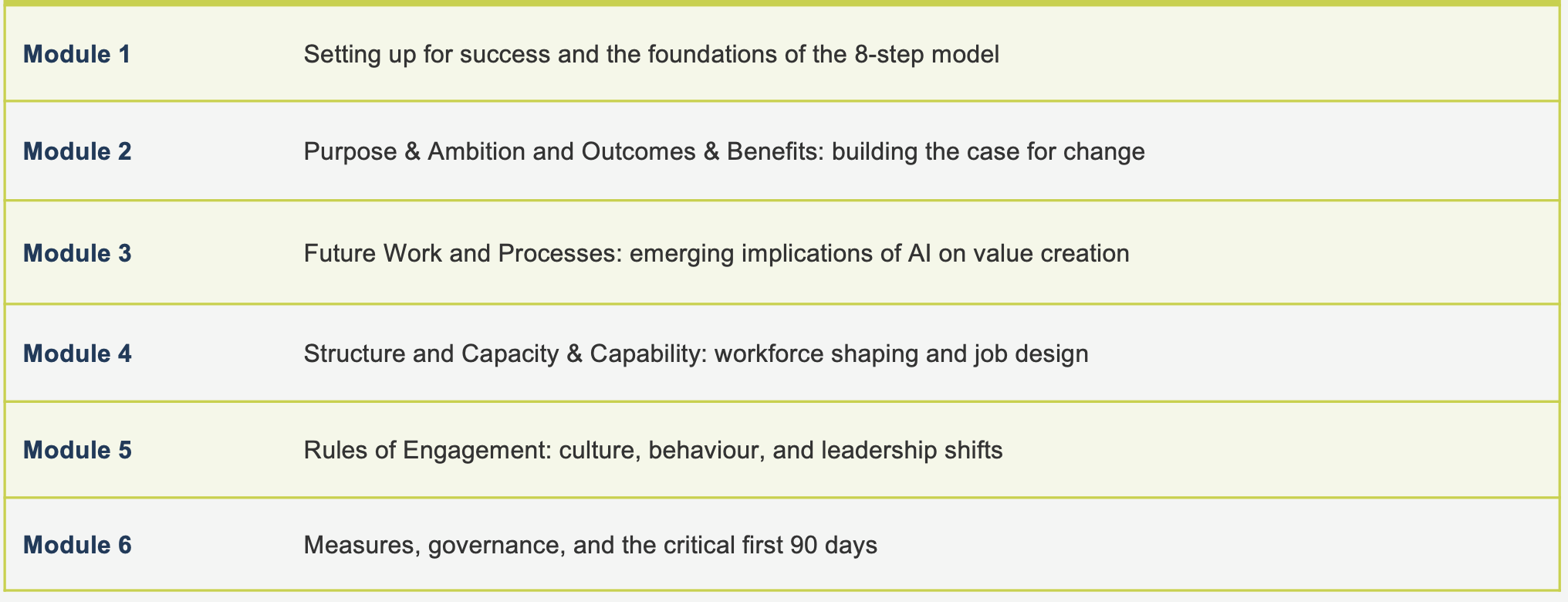
The condensing is deliberate. It reflects how the steps naturally cluster when you are doing this work for real. And it creates space for what matters most: applying the thinking to your own live challenge, with coaching and peer support.
If you’d like to learn more or join our upcoming programmes please register here.