Your design principles are your change management tool, and other lessons from building a gas factory
And why there were only ever going to be two hydrogeologists.
If you're leading or part of an organisation redesign right now, I'd guess at least one of these is true. You've been handed a brief that nobody can quite describe yet. You're under pressure to get the design right first time. You've spent a week in the detail of one tricky team and can't see your way out. Or you've had an idea you think is too bold to say out loud.
If any of that is you, you're in good company, and you've just described the conversation we had at our very first Let's Circle Back.
Let's Circle Back is our new monthly series of live conversations with leaders redesigning their organisations, starting with themselves. Each month Jill Foley & I sit down with someone who has actually led an organisation redesign, be that with their clients or as the client, and ask them the things people rarely get asked in public. Leading a redesign can feel quite lonely, and we wanted to bring together everyone who cares about this work so we can learn from each other.
Over 65 people registered for our first one, which blew my mind a little!! I don't expect everyone to turn up, I'm bad at registering for things then dropping out at the last minute ... but over 20 of us joined live, from Singapore, Malaysia, Yorkshire, Surrey, London, Ireland, Luxembourg, Ibiza, Pune, Brisbane and even Melbourne airport!
Jill opened the session with a quick tour of The Circle Line, our eight-step method for designing an organisation, so everyone had the steps in mind as they listened. She described it as very logical on paper, and "the reality is much messier", which is exactly what the next 40 minutes showed us.
Our first guest was Steve Giles. Steve ran Accenture's operating model practice across Asia Pacific and led Deloitte Australia's organisation design practice before that. He described what he loves about this work as the moment an executive team "lean back in their chair and look at the ceiling and say, 'Ah, yeah. That's it. You understand us.'"
"I need a gas factory, but I don't know what that looks like"
Before the session I asked Steve to pick one project that he felt represented everything I was going to ask him, and he chose an energy joint venture developing coal seam gas in Australia, just over ten years ago. He picked it because the industry was going through "rapid, unprecedented change" and "they didn't know what to do about it", and although the change we're seeing today is different, having to deal with constant and rapid change is something most leaders will recognise right now.
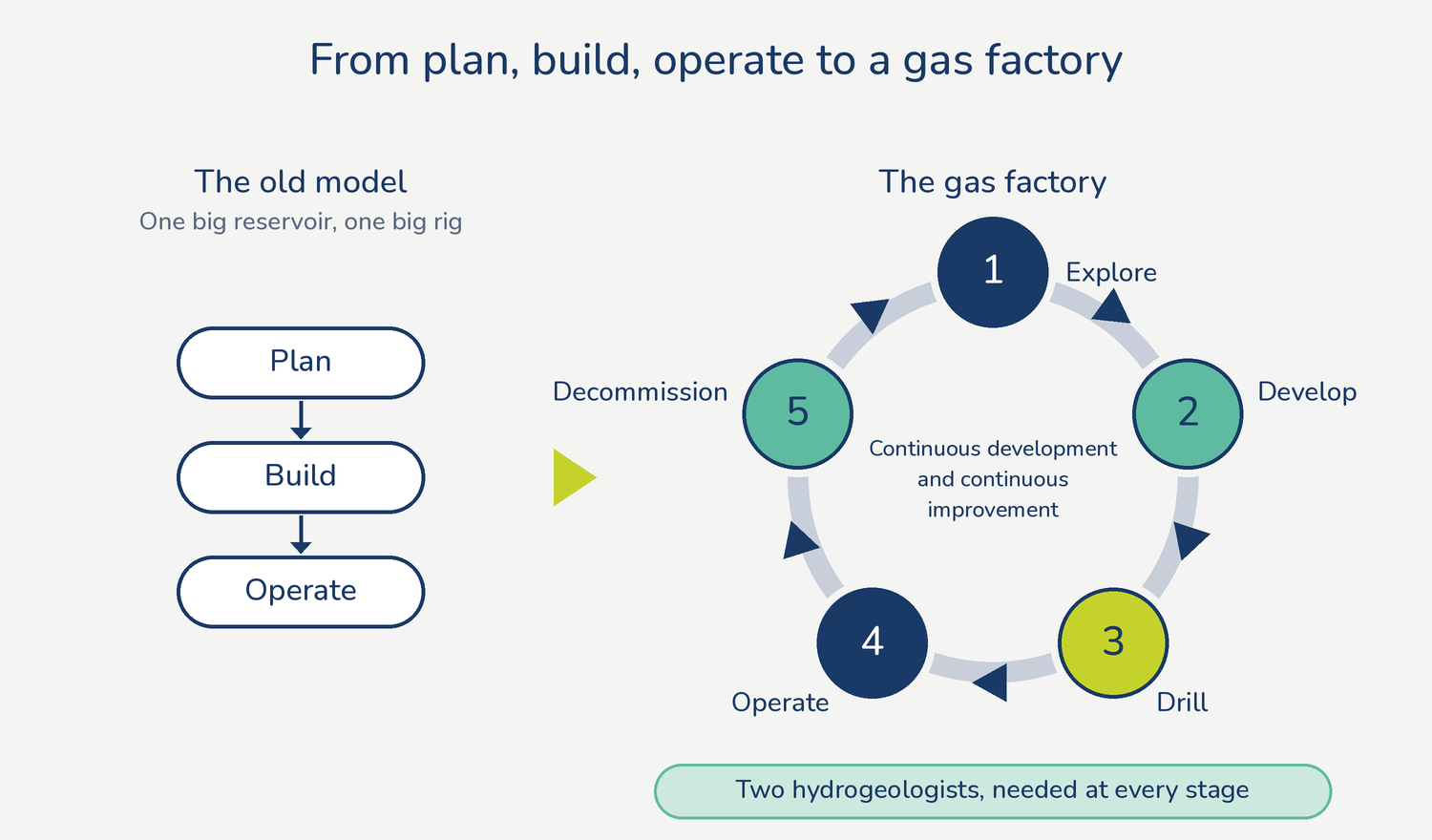
If, like me, you're not from the industry: conventional gas means finding one big reservoir, designing and building one big rig, and then extracting. Coal seam gas is embedded in coal beds across thousands of square kilometres, so you drill tens of thousands of wells, connect them, separate the water and pump the gas to the coast, over and over again, for fifty years or more.
When I asked what the client wanted him to solve, Steve explained that the whole industry had been organised around a plan, build, operate model, and this business needed to work much more like a factory, with continuous development and continuous improvement. The chief executive's brief was "I need a gas factory, but I don't know what that looks like. Look at my business and tell me what a gas factory looks like."
There is no perfect solution for where your scarcest experts sit
I asked Steve what the hardest part was, for the client and for him. He and the chief executive had mapped the business as a funnel: land being explored, then developed, then drilled, then operated, then decommissioned, with the funnel constantly being restocked. Each stage needs very different skills, and the organisation had finite people to cover all of them.
The hardest thing they ran up against was a small group of very specialist people. The hydrogeologists were critical at every single stage, from exploration to operations. Do you hire fifteen or twenty and put them in every part of the business, or keep a small core team that works across all of it? With cost pressure and a tiny market for these skills, the answer was "we only have two of them, at any given time. That's all we're ever going to have." So the design had to let two people work as a core team and also dip in and support every other part of the business, which Steve described as "not an uncommon kind of issue that you see with technical resources in a centre of expertise." Every organisation has its own version of the two hydrogeologists, and there's rarely a perfect place to put them.
There are always constraints in any design process, and knowing them early, along with the parameters within which you can design, is essential.
I said live on the call that I was going to have to google what a hydrogeologist was, and I did!! In case you don't know either, it's someone who studies groundwater and how it moves through soil and rock, and in coal seam gas you have to draw the water out of the coal before the gas will flow, which is why they were needed at every stage. And that's real life as an org design practitioner too. Your role is to be the expert in org design method and process, not the expert on every single business model. That's where you need the wisdom of the organisation, and enough creativity to not just cut and paste this organisation and make it the same as one of their competitors. Sometimes knowing too much about an organisation can be a limiting factor in design too, as you can't see any other possibilities or ways of doing it.
Developing the design principles together is the point
Next I asked Steve what the leadership team were debating as they tried to bring the new model to life. He talked about two kinds of tension, and the first was individual agendas, which you see in any executive team. Half of this team had come through the parent company's leadership development programme and were racing ahead with the solution, while the other half were still getting their heads around it, so a lot of the work was making sure everyone came along together.
Steve's answer to that was to spend real time up front on the root cause and the design principles, because if you short change those early conversations "you run the risk of misdiagnosing the problem, and then you're solving for something that's not actually the issue."
He told a story about a team member who turned up on day two with a set of design principles they'd written by themselves. They were logical and could probably have been used, but the executives hadn't been part of working through them, so they would have said "You came up with them. They don't mean anything to me."
This happens a lot. People on an OD project often think they have to have "a right answer", but actually the process of developing the design principles is the point. As Steve put it, if you don't spend enough time with the leadership team developing the principles and having them own them, "then they're very difficult to use further down the track because they are essentially a change management tool."
"They are essentially a change management tool"
I asked him to say a bit more about principles as a change management tool, because I think it's one of the most underrated points in this work. When you get into the design, leaders realise what they might be giving up: "You might be losing accountability. You might be losing direct control of resources. You might be losing budget. You might be losing your job." That's when principles they built together earn their keep, because they shift the conversation "away from, 'Well, I want,' 'No, I want,' two or three professionals arguing over something to something that's objective that they've agreed to together."
This is why, in The Circle Line, Jill calls agreeing the ambition and the design principles possibly the most important stage of all. It tests alignment, it anchors every later decision in the future, and it becomes the first chapter of the story you tell when you start to implement.
Someone in the chat asked whether this is only for big redesigns. Steve's view was to look at how many stakeholders are involved and how likely they are to disagree, and if it could get contentious, "you don't need 10, maybe three or four", just enough to keep the conversation on what's best for the organisation.
Aim for 80% right, then keep refining
The second tension Steve described was the technical one, and it took us back to the hydrogeologists. He said that when he described it earlier "it probably sounded easy and straightforward as a solution", and in reality he spent hours each day with individual executives working through where these and other technical roles should sit, how they'd be incentivised, and how to stop them being overloaded with four parts of the business asking for them at once. If you've ever debated what gets decided in the centre and what gets decided in the field, or what expertise sits in the centre and what you replicate in every business unit, you'll recognise it.
When I asked where they landed, the answer was a central specialist team with clear ways of working across the business, through meetings, processes, technology and a rough expectation of their time at each stage of an asset's life. Steve was very open that "We knew it wasn't the right solution. We knew that it was the best that we could get to. And when I say we, the executive team as well."
"We knew it wasn't the right solution. We knew that it was the best that we could get to."
He's seen organisations stall and agonise trying to get to perfection, and his advice is to get it about 80% right, implement, and then spend three to six months refining, fixing and testing. Even the parent company didn't have a model for running this kind of business, so this team was breaking new ground and was happy to test and correct as they went.
As someone said in the chat, "That's a really interesting point. I'm always aiming for perfection from day 1." I think a lot of us were nodding!
Leading a redesign is the leadership development programme you never asked for
Then I asked Steve the question I was most curious about. Anyone who's worked on a complex org design knows it can turn into a leadership development programme you never asked for, so what had he learnt about himself, as a leader, as a consultant and as a human?
He started by saying there's a point in every project where you become a coach, a guide and "almost a shoulder to cry on" for the executive team, and I had to admit that some weeks that feels like all of my job!
Then he shared three lessons.
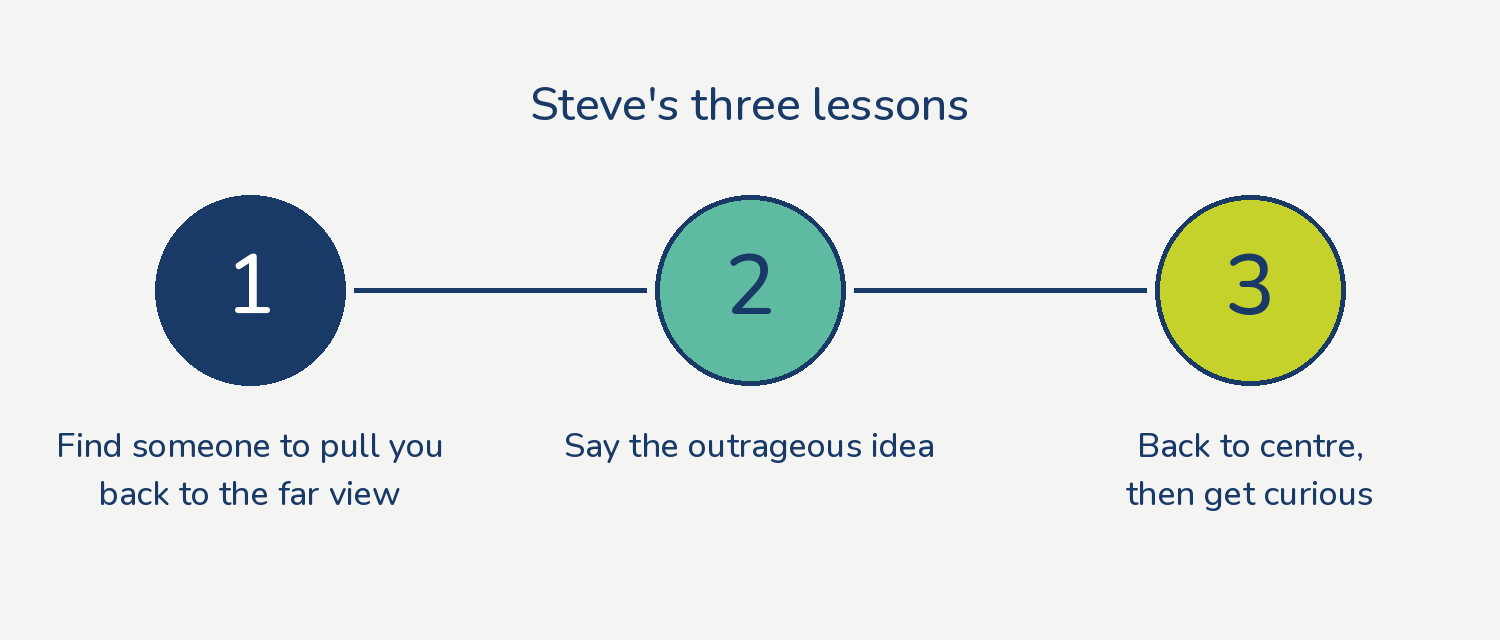
1. When you're lost in the detail, find someone who will pull you back to the far view, and set them up at the start.
On the gas project Steve was a senior manager leading a fairly junior team, and he got stuck for a week or two on where the specialist roles should sit, feeling the answer was all on his shoulders. He called the partner on the job, who drove down at the weekend for a coffee and just asked him questions. After about 45 minutes the partner said "I think you just described the answer to me."
His reflection was that "you're going around the circle three times. You need to go back to the front and think about the strategic context and the far view," and then back into the near view, backwards and forwards between the two. He took that with him when he became a partner himself, and still has to remind himself of it on every project.
There's often a lot of technicality in this work which we do need to understand, but we don't need to be experts in, and it's very easy to get into the weeds. Having that person who can pull you back out makes all the difference, and they're coaching questions, with the belief that you already know the answer. Steve had a partner to call on as an external consultant, and if you're working internally, his suggestion was to think early about who that person might be for you, whether that's your CHRO, your OD lead, someone else in the business or a design authority if your organisation has one.
2. Say the outrageous idea.
Steve has sat on ideas he thought were too extreme, only to hear a leader in a workshop suggest the exact same thing. So now he sets it up at the start: "I'm gonna push you past your comfort zone. I might ... I don't know your business like you know your business. I'm gonna suggest some things that you might think are crazy." He finds it gives clients permission to bring out ideas they've been sitting on for months too.
3. When a leader comes out fighting, get yourself back to centre and get curious.
Steve told me this story when we were preparing for the session, and I loved it. Years ago, as a senior consultant, he was playing back cost reduction recommendations to a bank during the credit crisis, in a boardroom with a table that felt the size of a tennis court. The executive running the mainland US business joined on a screen just as big, with a pair of boxing gloves on the wall behind him, and when Steve got to the recommendations for his functions he said "I'm a boxer, and I'm giving you fair warning because I'm about to beat up on you." Then he tore Steve apart, while nobody on the client side said a word. Steve felt tiny, and then he walked out of the boardroom and told himself "I'm not in pain, I'm not bleeding, the guy just disagreed with me."
Most of us won't face the boxing gloves (hopefully!!), but when we suggest things that challenge someone's power, authority or territory, we are often on the receiving end of their reaction. So two things: it's not about you, so get yourself back to centre, and then get curious about what the reaction is really about and what you might have missed, because you still need them to come on the journey with you. For that executive it was about losing power and autonomy, and his business was the hardest hit of all. Steve's other point was that this is where a good CEO steps in, because as consultants we don't hold that authority, so sometimes your job is to coach the CEO to take the decision back to the leadership team.
I think it's often harder when you're internal, because as externals we're given slightly more permission by our clients. When I asked Steve about that on the night, having been in both roles, his advice was that when a leader says "I get what you're saying, but no", don't take it personally, because they're doing that for reasons specific to them.
Test ideas one to one, then bring them together where nothing is scoffed at
Our preferred approach at The OD Collective is to co-create the design with the people doing the work, and we know clients don't always want to work that way, so I asked Steve how this client approached it.
They started with the executive team. Steve had all the org charts on the wall, and at the start or end of most days one of the executives would come in to talk through something they'd been mulling over. He'd test ideas and cross-check them between the executives, then bring the whole team together in a session where "Nothing's off the table, and nothing's scoffed at." To go deeper into the organisation, he always asks the leadership "Who else do I need to speak to understand this better?", and that usually brings in the two, three or four specialists who make the difference.
"Nothing's off the table, and nothing's scoffed at."
His reading list for anyone who wants to explore the practice further was Requisite Organization by Elliott Jaques, Reinventing Organizations by Frédéric Laloux, and The Organization Design Practitioner by Amy Kates and Greg Kesler.
Your questions took the conversation somewhere really useful too
Can a 70-person team create its own pocket of culture inside a huge organisation? Steve's view was to treat whatever sits underneath you as the unit you can influence and engage your team in what you're there to do. Jill added that the art of organisation design is knowing where you're going to change things and where you're going to leave them alone. Bottom up is a very legitimate way to work and typically gives you incremental change, transformation needs top down, and there's a third route, incubation, where you take away the normal rules to move fast. The danger comes when people try to copy it everywhere, and in folding it back in afterwards.
How do you know it's time to redesign? Jill shared her three reasons: a new opportunity, an existential threat, and what we call organisation debt, "the decisions that you should have made last year and that you chose to ignore." Steve added that organisations are dynamic and change while you're not watching, so you need to keep checking in. Underneath all of it you need good diagnostics, and a very human question: does our leadership team have the appetite to do this?
Jill closed on a point we come back to again and again. If you design standing in today, "you'll only ever come up with incremental ideas, and if they're that clever, you'll have done them anyway." Planting yourself three years into the future "gives you permission to think the unthinkable." That's what we mean by future back organisation design.
And the million-dollar question in the chat was whether AI should be treated as an operating model change. Our very short answer was that unless you're an AI business right now, it's very unlikely AI is the single driver of your operating model. It is one of the things you're designing for.
Why Jill & I set up The OD School
What struck me most listening back is how much of Steve's story was about him as well as the design: getting stuck, asking for help, finding his courage, and taking those lessons into every project since. Leading or being part of an org redesign is one of the best leadership development programmes you will ever be on, and it's going to stretch you and test you in ways you may not be prepared for.
That's why Jill & I set up The OD School. In our ten-week programme, everyone brings a live org design challenge they're facing and we support them, with one-to-one coaching, peer support and our Circle Line method, so you have a method you can follow, stories from people who've done it, and other leaders going through it alongside you.
Thanks for reading this far!! What's the one design principle that has saved you in a redesign?
Stay in touch
You can get the full recording of our conversation with Steve here.
Let's Circle Back is our monthly series of live conversations with leaders of organisation design, and you can register for the next one and watch past episodes here.
You can find out more about The OD School, our ten-week programme for leaders redesigning part of their organisation, and download the brochure here.
And if you'd like our top 10 tips, the things Jill & I wish we'd known earlier in our careers about organisation design, you can download them here.
This conversation was the first episode of Let's Circle Back, recorded live on 1st October 2026 with Steve Giles.