Organisation design is now a critical skill for HR, and it’s not about org charts
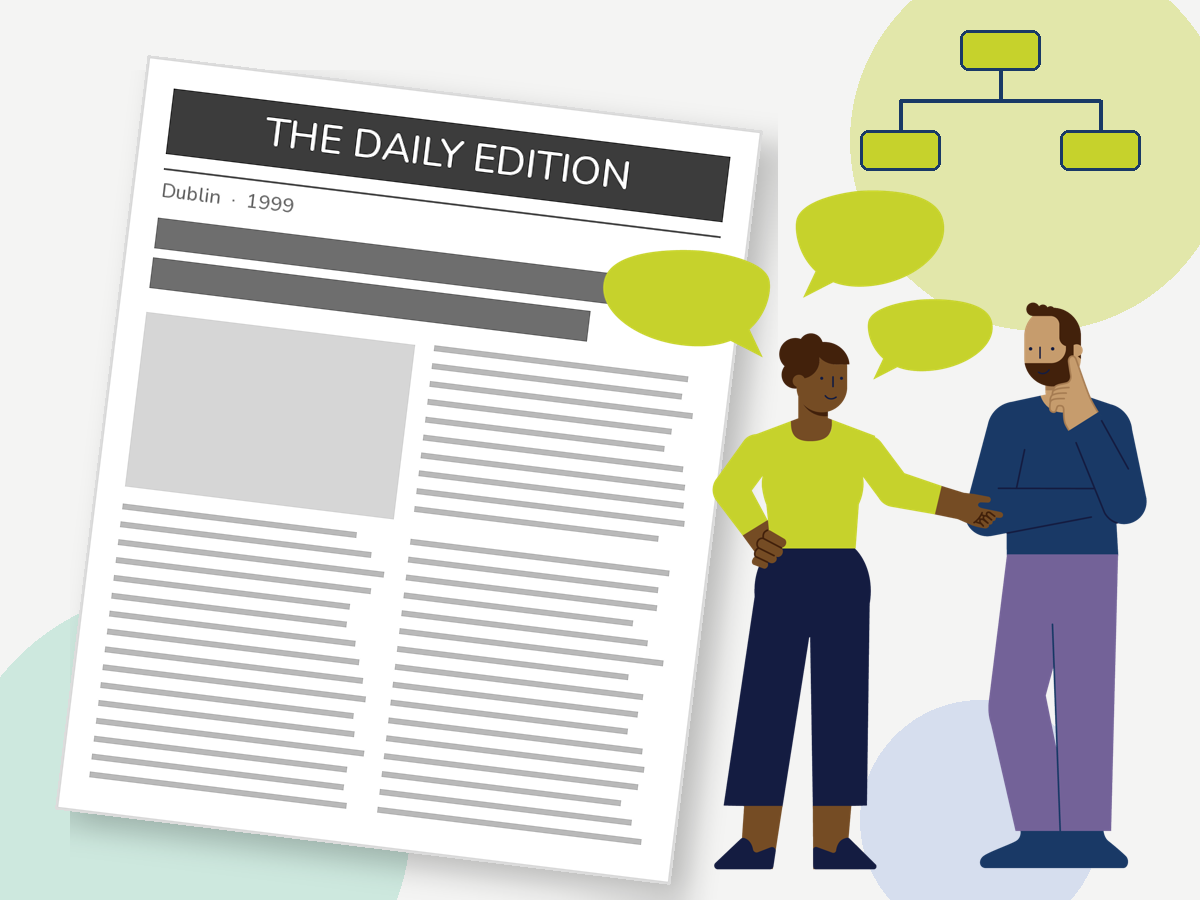
And why nobody will ever want to read a newspaper online (famous last words)
If you're a Chief People Officer, an HR Director or a senior HR business partner, it's pretty likely that somewhere over the last six to twelve months someone's come and had a conversation with you about AI. What it means for the business, what it means for your function, what it means for headcount, and probably, not far behind it, the words restructuring, efficiency, transformation and all of the other buzzwords that fly around an organisation. And the challenge if you're in HR is that the organisation is likely expecting you to do this many times over: once to support each part of the business through it, and then again for the HR function itself.
If these conversations have left you feeling a bit behind, or unsure where to start, or even overwhelmed, I'd like to offer you some reassurance, and then a challenge. The reassurance is that I have seen the original version of this movie before, and if you've been in organisational life for any length of time, so have you. The challenge is that the skill this moment asks of HR is organisation design.
Whilst none of us has seen this part 2 of the movie, organisations have been through many radical technology-led changes over the last thirty years. Are you old enough to remember when offices went from typewriters to computers, from faxes to email, from the internet to social media, from BlackBerry to iPhone? I am, and it's where my career started, working on organisation and operating model changes that were triggered by some sort of new emerging technology. So here's my part of the movie.
Dublin, 1999
It was 1999, I was 22 and on the graduate programme at Unisys, a mainframe company that had just brought in CEO Larry Weinbach from Arthur Andersen to turn it into a business that also sold professional services. I was part of a consultancy arm that was itself being designed as we went along. I was one of only two graduate psychologists they'd ever hired, so we had to do our graduate scheme as if we'd done an IT degree, talk about being thrown in the deep end.
My then colleague Jim McGrath and I were parachuted in to work with The Irish Times in Dublin, under the careful supervision of William Egerton and Huw Watkins, our managers and mentors at Unisys, who I still have to thank for throwing us in and backing us. And how exciting was that, a graduate working away in Dublin, living in a hotel Monday to Friday. That soon got tiring, as I spent most of my twenties living out of a suitcase, but it was an amazing experience and the life of a consultant!
The Irish Times was moving from the old print floor to computerised production, and our job was to work out who would do what work, and where, once the presses changed. My part was to process map what a lot of, quite frankly, big Irish men were doing in the printing presses and run workshops with them on how the work got done. And I remember, many a time, as a 22-year-old, short, blonde woman, being laughed at. Oh, this will never change, we will always print newspapers this way, and nobody will ever want to read a newspaper online. The Irish Times, as it happens, had gone online five years earlier, one of the first thirty newspapers in the world to do so. The website was there; the print floor just hadn't been designed around it yet. Looking back, that was an organisation design job in everything but name. It was being run as a technology project, so HR came in once the technology decisions were made and the people consequences needed managing.
I keep thinking about that story as we have these conversations about AI. A lot of things had to change back then, the printing, the culture, the ways of working, the editors, the whole way the newspaper was run, and it didn't happen overnight, and it didn't happen without conscious design. Somebody had to sit with the people doing the work and think through what the work now was and how it got done, and then organise around that. The trigger was a new technology; the work was organisation design.
My personal view is that we are putting the cart before the horse, letting the mention of AI drive the conversations about organisation design, when it should be good organisation design driving them, with AI as one of the things you're designing for as an enabler. AI conversations without design conversations are dangerous, because you end up automating work nobody has looked at properly, and potentially cutting roles that are essential before anyone has asked what the work now is. And AI conversations are also necessary, not to be avoided, because the alternative is like the guys in the print room: deciding this will never change, and finding out too late that it already has. The business is going to have these conversations whether or not you are part of them, and I would like HR functions to be involved in those conversations and not handed the implementation plans.
Here's the challenge
What we hear very often from our Chief People Officer clients is that they don't get invited in soon enough, or they get left as the implementers of decisions the business has already made, and almost every one of them, however accomplished, has said some version of “I'm not quite sure where to start”. Organisation design is now a critical skill for HR, and nobody taught you it. If you have it as a skill, you probably learned it on the fly, under stress, through a big reorg.
The World Economic Forum talked about this in May this year: AI transformation fails far more often because of organisation design choices than because of technology limitations, and the first of the four roles it sets out for the CHRO is design architect. Gartner's own research finds fewer than half of CHROs are confident of meeting their organisation design goals.
The first of the four roles the World Economic Forum sets out for the CHRO is design architect
Fewer than half of CHROs are confident of meeting their organisation design goals
Part of the reason these skills don't get built in house is that organisation design is seen as a specialist skill that has usually been handed out to consultancies, with HR as a stakeholder in the design and then the implementer of its consequences. And even when I do see HR teams actively involved in organisation design, in my view it's often too late, and only when the conversation is already about headcount, org charts and potentially consultation.
Our philosophy at The OD Collective is that organisation design is the deliberate work of aligning all the parts of your operating model so they enable your strategy. You design the work, and the structure follows. Design and culture are one conversation, because a brilliant design on old behaviours is just a pricier version of where you started. And it is a leadership skill, always on, that should live inside the organisation, in the leaders who run it and the HR teams who partner them, so that when the structural options finally come up, HR has been part of the strategy and operating model conversations that shaped them and can make informed choices.
Where should you start if you've been asked to sponsor or contribute to an organisation design or operating model transformation?
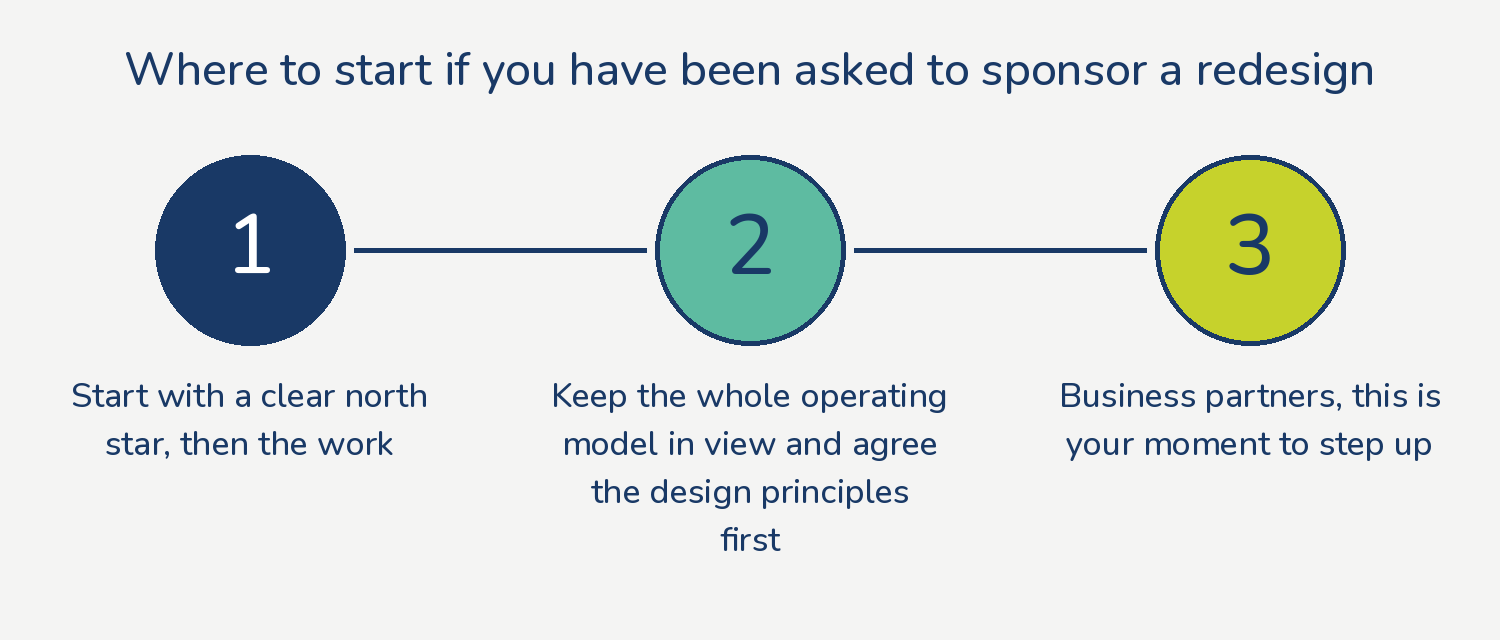
1. Start with a clear north star of the organisation strategy, then the work. You don't need a perfect strategy, you need enough direction to answer three questions: which parts of the business are growing, declining or need to change, whether this is incremental improvement or wholesale transformation, and how much risk leadership actually has appetite for.
Then ask what work each part of the business needs to do to get there. The org chart is not what drives performance. Designing the work does. Keep pulling the conversation back to it: what is the value-creating work, what has to change, what stays the same, what stops. It's the same question I asked on the print floor in 1999.
2. Keep the whole operating model in view, and agree the design principles before anyone re-draws an org chart. A restructure moves the boxes on an org chart. An operating model redesign changes how the work actually gets done, and that means the processes, the decision rights, the capabilities and the measures as well as the structure. Two things need designing before you even start design. The design principles: the handful of agreed rules that say what this redesign must protect, must change and will trade off, so every later choice can be tested against them. And the core work: the work that creates the most value for the business and the work that just keeps the lights on, because the design has to be built around the first and can be far more relaxed about the second. Most redesigns skip both and fix one part of the operating model while the rest stays out of line with it.
3. Business partners, this is your moment to step up. True business partnering means understanding the business you partner: its work, where it creates value, what's changing, and the whole of it, well beyond the HR components. The business partners who are ahead of the curve can sit with their divisional leader and help them design, because they understand the work and value creation of their part of the business as well as the leader does.
This is exactly why Jill Foley and I set up The OD School. We spent decades doing this work inside and alongside organisations, and in The OD School, we teach senior leaders, transformation leaders and the HR business partners who work alongside them our Circle Line method, so you have a method you can follow, stories from people who've done it, and the confidence to know where to go digging and which questions to ask when.
The trigger for organisation design will often change. This year it's AI, and there'll be another one behind it. The design questions stay the same, and so does the advantage of being the person who knows how to ask them.
If this has resonated with you
You can find out more about The OD School, our ten-week programme for leaders redesigning part of their organisation, and download the brochure here.
Participants from our Spring cohort said: “The OD School and the frameworks shared have been instrumental in helping me navigate organisational design at our company, helping create structure, navigate the difficulties of organisational change and deliver on the value we set out to deliver in the first place.”
Let’s Circle Back is our monthly series of live conversations with leaders of organisation design, sharing real life stories and lessons, and you can register and watch past episodes here.
And if you want our top tips, 10 things we wish we’d known when we led an org redesign, you can download the guide here.
Sources: World Economic Forum, “AI transformation is reshaping work. HR leaders must help redesign it”, David Henderson, 8th May 2026; Gartner, Organization design for CHROs. This article was first published on LinkedIn on 22nd September 2026.